
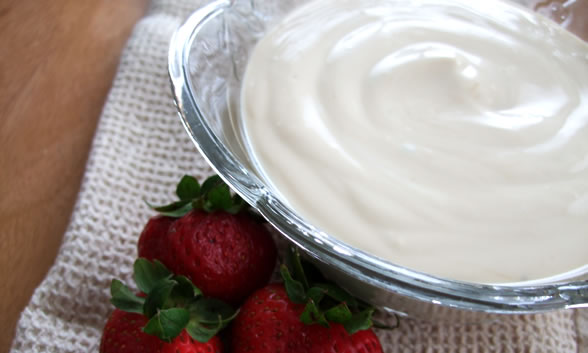
 Yogurt is a super-nutritious food, full of beneficial bacteria (Probiotics). Especially “homemade” yogurt, as most store-bought yogurts contain some sort of additives and/or thickeners-stabilizers.
We use yogurt a lot around here for making smoothies, eating plain (or with fruit) for a snack or great breakfast, and in the summer we make creamy yogurt popsicles. There are so many ways to enjoy yogurt. It makes great sauces as well, such as Tzatziki to go with burgers…yummm!
Well, now that I’m making myself hungry….let’s go ahead and get into the “How-To’s” of making yogurt.

Homemade Yogurt
You can adjust the ingredients according to how much yogurt you want to make. I usually make 1/2 gallon at a time, then I only have to make yogurt once a week (which is about how long yogurt will stay the freshest anyway).
- 1/2 gallon whole milk (can use raw milk, organic milk, or regular milk…but NOT ultra-pasteurized)
- 1/4 cup Plain Whole-Milk store-bought Yogurt, use a good quality brand that CONTAINS “Live” Cultures (I Like Brown Cow – Plain Cream Top)
*Note: After you make your first batch, save some of your homemade yogurt to make the next batch. Make yogurt once a week to keep the culture fresh.
You Will Also Need:
– Pan, big enough to heat milk in
– Spoon, to stir milk (always use a non-metal spoon to stir or serve dairy products, to keep them fresh longer)
– Glass Jar(s), with lid(s) (big enough to hold the amount of yogurt you are making)
– Insulated Cooler or smallish box, to hold your jar of yogurt
– Jar of very hot water, with lid on (if your house is cold/during the fall or winter months)
– Kitchen Towel(s) or a Small Blanket (to wrap your jar of yogurt in)
– Kitchen Thermometer, to measure the temp of the heated milk (NOT a candy or meat thermometer)
- Rinse inside of pan with cold water, dump out, but do not dry pan (this helps keep the milk from scorching and sticking to the bottom of pan).
- Pour milk into pan and warm over medium heat, stirring frequently. Allow the milk to come to 180F. Hold at 180F for 30 seconds to 1 minute, while constantly stirring. (It’s OK if it goes a degree or two over.)
- Remove pan from heat and allow to cool to 118F, stir every-so-often to help the milk cool faster. (If a skin/film forms on the surface, simply spoon it off and discard.)
- Meanwhile, measure out your yogurt starter culture (from the store-bought yogurt or homemade if this is a subsequent batch)…allow it to come to room temperature while the milk cools.
- Once the milk has reached 118F, not any higher, slowly whisk in the yogurt culture into the cooled milk. Make sure it is thoroughly combined.
- Pour this mixture into your glass jar(s) and cap. Do this all quickly, you want the milk to be at 110F-115F when you put it in the cooler. (Do not re-heat the milk once the culture is added.)
- Place filled-capped jar(s) inside insulated cooler or box. If it is particularly cold out, you may want to fill a jar with very hot tap water, cap, and place in the cooler/box as well. Wrap jar(s) with kitchen towel(s) or a blanket.
- Close cooler or box completely (I use a square soft-sided cooler that zippers shut).
- Allow to culture, undisturbed for 12-hours, or more, up to 24 hours. *Note: if culturing for 24-hours, at the 12-hour mark add a fresh jar of hot water in the cooler. This 24-hour yogurt will be more tart than the 12-hour yogurt, but will have more of the milk sugars eaten up.
- When yogurt done culturing, remove jar(s) from cooler and transfer to fridge to chill. Yogurt will thicken a little more in the fridge. Wait until well-chilled before serving or your yogurt will break-down and separate easily.
NOTE: Be sure to always set aside and save enough of the plain homemade yogurt to use for your next batch.
*Sugar-Free / Grain-Free
 Email To A Friend
 Print This Page



I just got back from France and had the MOST wonderful yogurt in little red clay jars. It was thick, creaming and absolutely divine. Ingredients were whole milk, cream, sugar, vanilla bean caviar and live cultures. It seemed to have been incubated right in the jars, but it was SO thick. Almost like crème brulee. No whey, no milk separation. How is it done? I’d love to make it here at home, but can’t figure it out. Thank you!!
Arainna, I’ve never had this yogurt nor witnessed its production so I cannot provide you with an exact answer. Though based on the ingredients, it just sounds like it has a much higher fat content…likely due to the “cream”. In general the higher the fat content in the milk the creamier and thicker the yogurt will turn out. So you could try fiddling with the recipe by reducing some of the whole milk and replacing it with cream. If you like you can add a little sugar as well, though I would be careful to not add too much or it could interfere with the culturing of the yogurt. Good luck!
Hi, Shannon,
It’s been a long time since I’ve visited this info, but I was reading through some of the comments and problems, and I wonder if what some readers are experiencing with the separation of milk isn’t the natural clabbering process? I was reading about this. It looks really nasty on your counter, but the milk isn’t “gone bad”. I noticed when we have our raw milk, and it goes past it’s sweetest time, it just gradually stops tasting sweet. It doesn’t have a moldy or yeasty smell; it doesn’t have any slime or anything that indicates spoilage. It just stops tasting as lovely and sweet. I think perhaps that’s why it works to use up your old raw milk in baking in place of, say, buttermilk. How many recipes do we see where it calls for the milk to be soured with an acid like vinegar or lemon? Your raw milk will naturally do this over a stretch of time…I’ve even used it when it was quite old, but not moldy, with great results. Now, everyone needs to use their common sense, and if they think the milk smells gross, then throw it in your garden or garbage. It’s up to all of us to exercise discretion in our kitchens. =) What are your thoughts on this?
Nancy.
Nancy, The natural clabbering process does have separation of milk solids from the whey, but when people have this with their yogurt it is different since they added a culture to the milk after it was so to speak pasteurized, this is not clabbered milk. Keep in mind any milk that has been pasteurized I would not recommend to be clabbered, since the natural bacteria that protect the milk from spoiling is dead.
Souring with vinegar or lemon is the fast way to get milk to this state and can be done with pasteurized milk. Pasteurized milk can not be left on the counter at room temp as it will rot and grow harmful bacteria.
Hi! Thanks for your clear, concise explaination. I’m wondering, though, why you begin with raw milk, yet use the heating/cooling method typical in pasturized milk methods. Doesn’t heating the milk so high destroy enzymes, which is the main point of obtaining raw milk? Heating the milk even to just 95F seems to be enough to culture it for me – and I did have good results in a dehydrator, but would like to try your cooler method. I learned this method in Sally Fallon’s (sp?) “Nourishing Traditions”, and have made cheese from raw milk with similar temperatures.
Thanks for any insight you can give,
Nancy.
Nancy, I begin with raw milk to get a “clean” pure product. When making homemade yogurt, I found it is very important to heat the milk up to 180 degrees F to get a good, quality, “consistently” thick creamy yogurt. If you do not heat the milk up to 180F then the good bacteria in the raw milk will compete with the yogurt culture and not produce a good yogurt. I have experimented myself with various ways of making yogurt – in a yogurt maker, not heating the milk to 180, heating it to 180F, in a crockpot, etc…. you name I’ve tried it. This yogurt recipe is the result of a lot of testing. I found this method, outlined in this recipe, produces the “best results”. Remember when heating the milk to 180F at home, you are going to do so over low to medium heat, stirring often, and once it reaches 180F immediately remove it from the heat. So you are not “boiling” the milk or keeping it at a high heat for a long time. Hope this info helps.
Yes! This helps very much. I’m still fighting the idea of heating my raw milk, but what you said does make sense re. not keeping it high for too long, nor boiling it. I do appreciate you answering. It’s so good to find a site like this. We’ve had Sally Fallon(sp)’s book for a number of years, and I’m re-visiting some things. Very exciting! What was the “program” you found to help you find better health you mention in your “about you” section?
Blessings,
Nancy.
Nancy, you are so welcome. Glad you are enjoying the site.
I can’t recall the exact book. But if you follow the recipes and articles here on the web site, that is basically it in a nutshell.
I just made this and it was delicious. BUT it was way too runny. I strained it with cheese cloth and got it to the “right” thickness for us but the two large jars yielded less than one jar after straining. Is there a better technique to make it thicker from the start? I cultured it for 22 hours. Thanks!
Lourdes, thanks for writing. I am sorry to hear about your yogurt not turning out so well. Not being there I do not know what you did or didn’t do. So I offer a few things you may look at to see what the issue may be.
How homemade yogurt turns out directly depends on the ingredients used in making it.
What type of milk was used, ie. how much fat is in the milk?
The lower the fat content of the milk, the thinner your yogurt will be. I use raw whole milk that is around 10% fat.
What type of store-bought yogurt was used as the culture?
If it wasn’t alive and active it won’t make good yogurt (some yogurts at the store are not alive). I use Brown Cow Plain Cream Top Yogurt and get excellent yogurt everytime.
Was a reliable thermometer used to check the temp when heating and cooling the yogurt?
The temp is very important. You must cool the milk to 118F before adding the yogurt culture or you will “kill” it and it will not produce good yogurt.
Did the jar stay properly warm and insulated during the incubation period?
If the jar does gets to cold or hot during incubation the yogurt will not culture properly. I place mine in a small-ish insulated cooler wrapped in a few kitchen towels and incubate for 12 hours.
With all of this my yogurt turns out great everytime. Those I’ve instructed in classes using these methods also have great results.
Maybe go over the above in bold and see if there is something that was overlooked or that needs remedied. Let us know how things work out from here.
I am having trouble making this yogurt. I started last fall following your instructions and putting it into my dehydrator to keep warm instead of the cooler. I worked wonderful for a while then one batch the milk separated into whey and a white solid chunky substance. I eventually got it working again after Christmas. It is happening again now. I made yogurt last night following these instructions and all 4 quarts look like the whey has separated. I used a store bought yogurt for the starter culture. It was that White Mountain Bulgarian whole milk yogurt. So I have 2 questions. 1. is it safe to put in smoothies if it smells like yogurt? 2. what keeps going wrong?
If the yogurt smells fine then it should be okay to put in smoothies. But if it smells bad or yeasty then I would toss it.
As far as what you are doing wrong…
All I can say is the problems you are having is the exact reason I stopped using my “yogurt maker”. It is extra heat that is not needed. The yogurt simply needs to stay “insulated”, it is already producing its own heat by consuming the lactose in the milk. So the additional heat source is probably just causing too much heat.
Heat + Heat = too much Heat.
When I stopped trying to use “fancy” equipment for making my homemade yogurt is when my yogurt came out the way it’s supposed to every-time. So my advice to you is use your dehydrator for what it’s good at, ie. drying nuts, fruit, making jerky etc. And go back to the simpler way of making the yogurt.
Remember the K.I.S.S. principal (slightly modified by me):
Keep It Super Simple!
I seem to have a problem when I heat raw milk. It always curdles. I don’t have a thermometer but i heat it on med heat and not even to boiling. It curdles as soon as it gets hot, even though i stir it regularly. Am i doing something wrong?
From what you’ve said, I do not think you are doing anything wrong. Though I really recommend that you get a thermometer. They do not cost that much and it is very important when making yogurt to get all the temps just right. If you live near a Wal-mart you can get a decent digital thermometer for around $10 to $12.
The only thing I wonder about is the acidity of your milk. I found the following question on the internet…
Do you leave your milk out a room temp at all? Does the farm chill it immediately? Is it kept cold while being transported to you?
These are all good questions to know the answers to.
When I make yogurt it come out a bit grittier and not creamy like the store. Is there something I am doing wrong or is that just the way it comes out? I do not mind but my family is having a problem with the texture. This is after I strain it.
Yes I agree that sometimes my homemade yogurt is not always as smooth as store bought. I am not sure why this is, but I usually just give it a stir in my bowl (that I am eating it in) and it smooths out.
How and why are you straining your yogurt?
On a side note – One reason that homemade yogurt is far better for you than store-bought yogurt is it is MUCH higher in probiotics (the live “good” bacteria). Store-bought yogurt is allowed a 90% death-rate before you purchase it. Meaning it starts off with a certain number of live bacteria when it is manufactured. But by the time you get it home it could have only 10% of the live bacteria left. Whereas homemade yogurt doesn’t lose bacteria (or very minimally).
Thanks for a great how-to. A couple questions, though:
What is the point of putting the hot jar in the cooler? I assume to keep the culture warmed, but why would you only do this if making less than a half gallon?
Also, not sure what purpose the wrapping with towel serves.
Thanks!
The inoculated milk jar goes into the cooler to stay insulated and warm throughout the culturing process. Wrapping in towels helps the jar(s) to stay insulated as well. Both of these steps are important, as the yogurt will not culture properly if it is too cool. It needs to stay at 110F to 115F, no more no less.
If you are making less than 1/2-Gallon of yogurt you will need some additional heat source to keep it warm enough in the cooler. You see when making a larger amount of yogurt at a time, the heat from the warmed milk will be enough to keep itself warm in the cooler…..not so with a small batch. This is where another jar filled with HOT water will help, or a heating pad etc. would work as well to keep a smaller batch warm.
How long does the yogurt keep in the fridge?
The yogurt will last for at least 7 to 10 days, maybe a little longer, depending. Remember “homemade” foods never last as long as store-bought because of the lack of preservatives and additives. But, the great thing is that they taste so much better, and are much healthier for you.
You will still want to make new “fresh” yogurt once a week… because you will be using a portion from the previous batch as your “culture” to make the next batch of yogurt. Making yogurt once a week helps to ensure that your next batch will culture correctly, because your culture is fresher… not weakened or stale.
Could you give me advice on this:
– Does it have to be Plain Whole-Milk Yogurt? I usually have on hand the low fat and I wonder what would be the difference?
– I work with raw milk and if the milk is getting close to it last days (still good but maybe only for a day) Can I make the yogurt and will it be still good as long as from very fresh milk?
Any insight on those questions?
You could try the low-fat yogurt. I’m sure it would work, just not sure if the resulting homemade yogurt would be as creamy.
I use raw milk as well when making my yogurt. I believe it is best to use fairly fresh milk when making yogurt or it may not culture properly and/or last as long.