
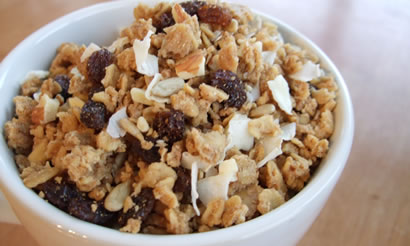
 This granola is something you can feel good about eating and letting your kids eat as well. It is great as a breakfast cereal with some raw milk and as a topping for yogurt as well. The oats and rye flakes are “soaked overnight”, making them more easily digestible and unlocking vital nutrients. You can read more about soaking grains in this article or in this amazing book by Sally Fallon, Nourishing Traditions: The Cookbook that Challenges Politically Correct Nutrition and the Diet Dictocrats.
If you’ve never read about how store-bought cereals are made, I highly recommend this article from the Weston A. Price Foundation…it has made me rethink things and for this, I no longer buy any store-bought cereals.
Homemade “Soaked” Granola
Prep time
Cook time
Total time
Homemade Granola is the best! This version takes advantage of a quick overnight "soaking" to unlock the nutrition and make it that much healthier for you and your family.
Recipe type: Breakfast
Serves: 10 cups
Ingredients
- 7 cups organic thick-rolled oats
- 1 cup rye flakes
- ½ cup (1 stick) butter, melted
- ½ cup coconut oil, melted
- 1 can (14 ounces) organic coconut milk (or 1½ cups buttermilk)
- 2 cups filtered water
- 4 Tablespoons raw coconut water vinegar or raw apple cider vinegar (like Bragg's)
- 1 to 1¼ cups raw honey or maple syrup (use any combination you wish...I use ½ cup maple syrup and about ¾ cup raw honey)
- 1 teaspoon sea salt
- 1 Tablespoon ground cinnamon
- 1 Tablespoon vanilla extract
Add-Ins: (choose any or all of the following to suit your taste)
- 1 cup organic raisins
- 1 cup dried coconut flakes or chips
- 1 cup chopped almonds (soaked & dried using the NT method)
- ½ cup sunflower seeds
- any other dried fruit or nuts
Instructions
- Mix oats and rye flakes with the melted butter, coconut oil, coconut milk (or buttermilk), vinegar and water in a large bowl. Cover bowl with plastic wrap or a cloth and let sit for 12 to 24 hours.
- After the soaking, preheat oven to 200° F.
- Place honey, maple syrup, salt, cinnamon, and vanilla in a glass measuring cup in a small pot of warm water on the stove. Bring water to a gentle simmer, stirring honey mixture until melted and mixed thoroughly.
- Combine the honey and oat mixture, mixing to completely incorporate. Spread the mixture out over two large parchment paper-lined baking sheets. Bake for 4-8 hours, or until granola is dry and mostly crisp; after a couple of hours in the oven you may want to slightly break up the granola and also fluff it up (stir it around) to allow for faster cooking/drying time.
- When granola is mostly crisp, turn off oven and leave baking sheets inside with door closed until completely cooled. The granola will get slightly crispier as it cools.
- Mix in any add-ins you like, such as: raisins, dried coconut, sunflower seeds, other dried fruit and/or nuts. Store in an airtight container.
Notes
Makes 10-cups of granola (without add-ins).

I’m confused about this process. When I soak dry beans overnight to break down the phytic acid, lectins etc. I drain the water, rinse the beans, add fresh water and cook. If we are soaking the oats to get rid of the phytic acid wouldn’t we want to use enough liquid to be able to drain off the soaking water at least? Separating it from the oats and then incorporating the liquid in the recipe seems counter productive. Does a chemical reaction take place turning the phytic acid into a neutral compound that is harmless?
Kathy, soaking beans and grains/flour is a slightly different process. When soaking flour or grains we use an acidic medium to neutralize the phytic acid within them. So when you asked above “Does a chemical reaction take place turning the phytic acid into a neutral compound that is harmless?”, the answer is YES. The phytic acid is neutralized which “unlocks” the nutrition within the grain/flour and makes it more easily digestible.
Hi… I am going to soak Bob’s Red Mill Old Fashioned Rolled Oats, can I also use Bob’s Red Mill 5 Grain Rolled Hot Cereal Whole Grain? It has whole grain oats, wheat, rye, barley, triticale and flaxseed.
Adriana, I’ve never tried using the Bob’s Red Mill 5 Grain Rolled Hot Cereal before so I cannot say for sure if it will work. Though since it is a rolled cereal it should work. Let us know how it works out for you though 🙂
I’m just wondering… With what you said about needing the rye flakes to help the digestibility of the oats and add phytase (I hope that’s the correct word!?) would that also mean that when I make “soaked oatmeal” and leave it overnight that it’s still not really helping the way it should? Should I also be adding rye flakes to my soaked oatmeal? Sorry if this is a silly question, just trying to understand!
Rae, you would get better results (phytic acid removal) if you did indeed add a little bit of rye flakes to your oatmeal when soaking.
Phytase is an enzyme which breaks down phytate (or phytic acid) and therefore improves nutrient and amino acid availability and digestibility. Grains like oats, rice, millet, and corn are low in phytase. When soaking any of these low phytase grains it is beneficial to substitute approximately 10% of the low-phytase grain/flour with a high-phytase source such as wheat, rye, or buckwheat. So for a recipe that calls for 2 cups of grain/flour you would remove about 1/4 cup and replace it with a high phytase grain/flour.
Hope this info helps, and thanks for stopping by!
Hi! Would buckwheat groats or wheat germ be appropriate substitutions for the rye flakes in this recipe? I am unfamiliar with both in cooking but have them in my pantry along with all other ingredients except rye. Thank you 🙂
Please disregard! I found my answer below 🙂
Is this site still open for questions? If so, should there still be liquid in the bottom of the bowl after 24 hour soak? Do we incorporate this or drain it? Thank you~
Rudy, thanks for the question. I’ve made this recipe many many times and don’t recall ever having any extra liquid in the bottom of the bowl. With that said, I would just stir it in and follow with the remaining steps in the recipe 🙂
Hi! I love your recipes and really appreciate all the research you’ve done. I’m new to the “soaking” technique and curious: can I soak oats and/or nuts in just plain water overnight? And then would there be nutrients lost if I strained the water and then used fresh liquids to continue on with the recipe? I’ve made almond milk this way in the past, don’t recall where I heard that it was okay to do. Wondering if I could do the same with granola. Thanks so much!
Lindsey, thanks for stopping by. Nut cans be soaked in water with a little salt added. But grains such as oats, wheat, spelt etc. need to be soaked in some sort of acidic medium. This could be buttermilk, yogurt, kefir, or water with a little raw apple cider vinegar added. The acidic liquid will neutralize the phytic acid in the grains and make the nutrients more readily available and easier to digest. The soaking liquid only needs to be drained off when able, such as in nuts, beans, etc.
Help! Made this with milk kefir for soaking liquid and it smelled strongly of alcohol! Is it still safe to eat after 6 to 8 hr in the oven? I made it with coconut milk before and it was AMAZING! We gobbled it up in one week! Ok I ate most of it lol
Rifaa, I doubt that it is alcohol you’re smelling. My guess is it’s the kefir giving off a “yeasty” smell. Kefir can smell kind of “beer-ish” sometimes. It should be safe to to bake and then eat. Who knows the kefir may give it a pleasant tangy taste. Let us know 🙂
I’m wondering if anyone has had luck using the dehydrater with this recipe? If so what temp did you use and for how long? Thanks!
Lauren, I haven’t tried using the dehydrator. So I really couldn’t help with times and temps. If you’re interested in using the dehydrator, I would just give it a go. I just don’t have enough trays in my dehydrator to try it, so I use the oven.
I have GOT to try this!!! My biggest question though, is why coconut milk? We have jersey cows, so usually have raw milk around…can I use that in place of the other milk or buttermilk? Right now our cows aren’t in milk, but I know where I can get some raw milk till we have our own again, so would much rather use that than have to find where to buy coconut milk. :-))
Deb, thanks for writing!
You do not have to use the coconut milk. I just like it for the flavor it adds to the granola. Any milk would work in this recipe – raw milk, regular whole milk, almond milk, etc. Feel free to use what milk you like or have on hand. 🙂
Thanks so much!! I have some in my dehydrator as I type…can’t wait to try it! :-))
Would it work to add the almonds to the oats during the soaking process?
Stephanie, I have not tried adding the almonds to the oats during soaking. Theoretically it should work. Please let us all know if you do try it.
Has anyone tried drying this in a dehydrator? I imagine it would take a lot more time but might preserve more of the nutrients?
Do you have the nutritional information for this soaked granola? i.e., serving size, calories, etc?
Pat, we don’t focus on serving size or calories. These are not the best areas to focus on. A serving size can be anything the maker wants it to be and calories tell us nothing about a food. It was not until 1990 that the Nutrition Labeling and Education Act (NLEA) was passed, which is the current nutrition label we see today. Our forefathers payed attention to foods and how they were made into meals. We focus on foods and meals, nutrition controls weight.
I really want to try this, but have a problem with my oven…the lowest temp it has is 260, will that be to high, so it kills to many nutrients…or burns the granola? I do have a dehydrator, but it’s highest setting is 160 so don’t know that it would work either. LOL Any thoughts on how I could still make this so it doesn’t loose to many nutrients? Thanks!
Deb, strange that your lowest oven temp setting is 260F. Well anyhow, I would try the 260 degrees and maybe leave the oven door cracked occasionally or just watch the granola well to be sure it doesn’t burn.
How do you store it? How long is it shelf stable or how can I extend it without it getting mushy… Freezing?
This is a homemade “natural” product so will not last as long as store-bought granola’s. With that said, this granola should keep for at least 1 month, possible more, stored in a air-tight container/canister in the pantry or cupboard. I do not think freezing it would be a good idea as it might “cause” it to go mushy.
why do you used canned coconut milk, is it any different from the kind you can buy in a tetra-pack? and also can the oven temp be set higher?
Lilly, thanks for asking about that.
Most people do not know that the coconut milk you are speaking of, in the tetra-pack, is not true coconut milk. It is in-fact a coconut milk “beverage”. I do not personally care for it because it contains too many “ingredients” and usually contains sugar.
Here is a list of ingredients in the popular brand of tetra-pack coconut milk beverage:
Coconut Cream (Water, Coconut, Guar Gum), Organic Evaporated Cane Juice, Calcium Phosphate, Magnesium Phosphate, Carrageenan, Vitamin A Palmitate, Vitamin D-2, L-Selenomethionine (Selenium), Zinc Oxide, Folic Acid, Vitamin B-12.
In my opinion coconut milk should not contain added sugar or vitamins (which are generally synthetic). And carrageenan is another problem ingredient to look out for on food labels (trying researching it, as it is too much to get into here).
True coconut milk, in a can, contains usually only 2 to 3 ingredients like – coconut milk, water, guar gum. So for this reason I stick with the coconut milk in a can. Though with all that said, if you desired, you can use the tetra-pack coconut milk/beverage in the granola recipe… it should still “work”.
About the oven temp, I try to keep it fairly “low” for two reasons – 1) I do not want the heat so high that I kill everything in the granola, I want to try and maintain some of its integrity. 2) I do not want the heat too high that the granola burns before I know it.
Hope this has answered your questions. Thanks again for asking 🙂
Have you ever tried making this in the slow cooker? I’ve been searching for a recipe using soaked oats but finished in the slow cooker instead of the oven to simplify the process. There are lots of recipes for slow cooker granola but I’d like to find one that successfully also incorporates the soaked oats.
Jennifer,
I am a little confused. I do not think it is possible to make “granola” in a slow cooker. I think it would just be “oatmeal” (porridge). Granola is cooked and “toasted” in the oven so it will be crunchy like it is meant to be. If oatmeal/porridge is what you are referring to, then yes you can cook soaked oats in a slow cooker. But I do not think this is the recipe you are looking for to do that.
I always thoughts so too, but recently I’ve found many recipes for crockpot or slow cooker (crunchy) granola. If you do a google search you will see what I mean (didn’t know if you wanted me posting links here?).
Oh really? Wow that is something I never would’ve thought of. Thank you for letting me know. I will do a search and see what you mean… very interesting. 🙂
Questions about this recipe. Why do you add the butter and coconut oil to the oats for the soaking process? And if I used buttermilk or yogurt would I also need vinegar? Also should I add some wheat flour to the oats to better release the bad stuff (sorry the name eludes me right now)? And finally are Rye flakes the same as rolled rye?
If you do not add the butter and coconut oil in the soaking process their wouldn’t be enough liquid for a proper “soaking”.
If you use buttermilk then the vinegar is not needed in the recipe.
The oats are low in phytase which helps is the neutralization of Phytic Acid, this is why we add the rye flakes (also known as rolled rye). Rye is high in phytase. If you are not going to use the rye then you would need to add some whole wheat or another grain that is high in phytase.
I am confused why it is important to use RYE or whole wheat? We generally try to eat a low gluten diet and the only wheat we use is Einkorn which does not come in rolled form. Thanks, looks like a great recipe.
Lisa, sorry for any confusion.
Rolled Oats are low in phytase. The phytase is what helps with the neutralization of Phytic Acid during the soaking process. If you do not use the Rye Flakes or some other alternative (please see other options below), then the soaking process will not be efficient. If you cannot or do not want to use the rolled rye then you would need to add some other grain that is high in phytase during the soaking process.
The amount of rye, or other phytase containing grain, used in the recipe is small compared to the total amount that the recipe yields. So the gluten amount would be very low per serving. (BTW – rye is extremely low in gluten.)
I hope I’ve helped clear this up. Please let me know if you needed further explanation.